What Codex really puts into each project
Time Momentum is a Codex usage tracker for client work: it records every Codex session through its hooks, assigns it to the client project and shows what it cost.
- 30 days of Pro
- No credit card
- Then continue on Free
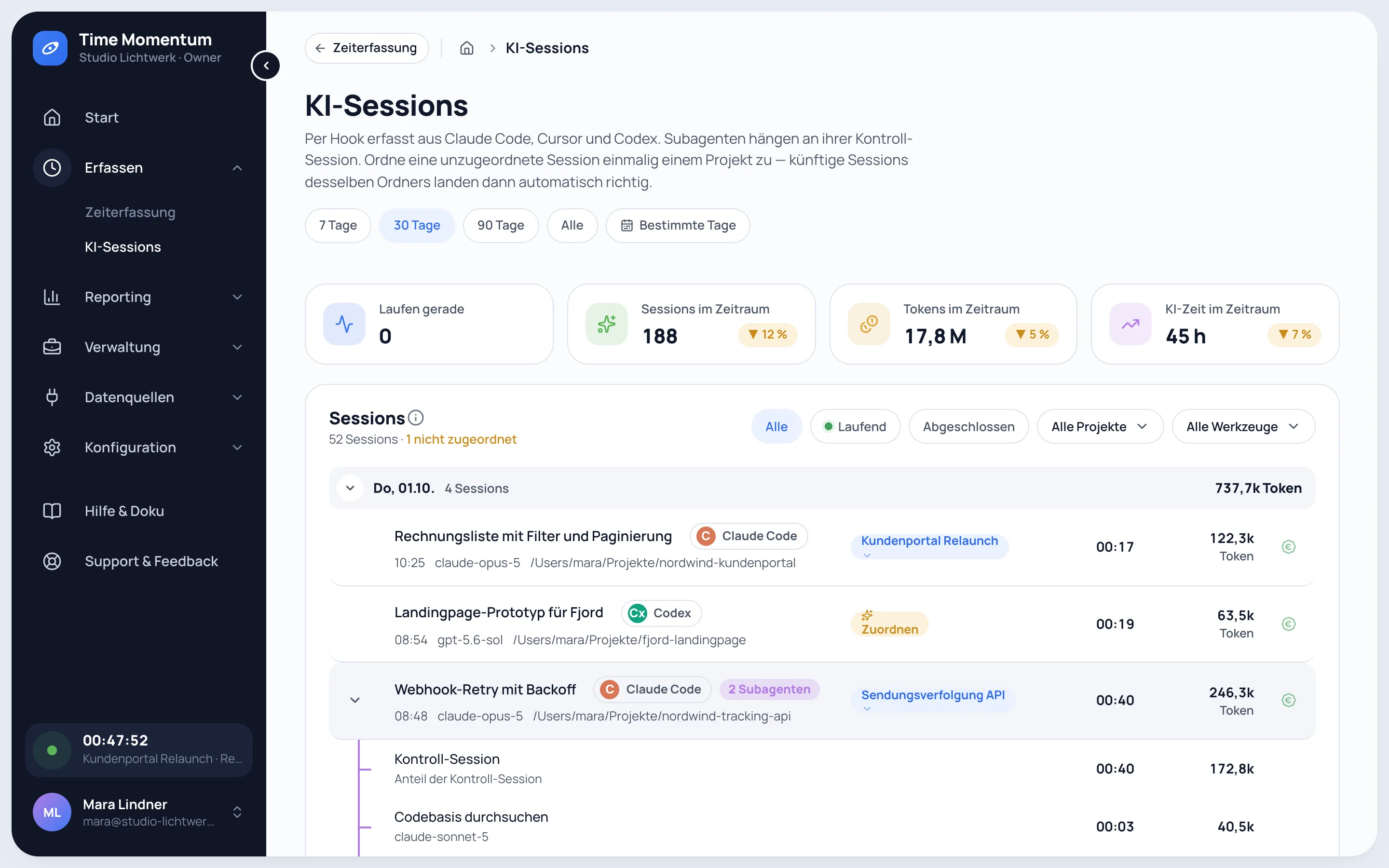
What is captured from Codex
- Every session with its model.
- Tokens from the local rollout: input, output and cache.
- Subagents as their own sessions with their own tokens.
- Active agent runtime, measured from the rollout.
- A title per session: the thread name, else a short title from the first prompt.
- The folders the session wrote to, for assigning it to the right project.
- Commits come in through the GitHub connection.
From usage to the client
Each session is priced at the model's list price when it started, with input, output and cache priced separately, and converted to euros. On a subscription such as Claude Max or ChatGPT, you can instead split the monthly fee across your projects by token share.
On the invoice, AI work appears as cost with a markup, as a token quantity at your price, or as active runtime at an hourly rate. Passing AI costs on is part of Pro.
Setup
- Create an API key in the app and run
curl -fsSL https://app.time-momentum.com/install.sh | shon macOS or Linux (Node.js 22.14 or later). It installs the tm command line and asks for the key. - It adds its hooks to ~/.codex/hooks.json. Confirm the new hooks once in Codex under /hooks.
- Past sessions, including archived ones, are imported right away.
What leaves your machine
Prompts, responses and code never leave your machine. Time Momentum receives the model, tokens, runtime, working folder, repository and a session title. Where a tool keeps no title, the first prompt is sent shortened to 200 characters; Time Momentum turns it into a short title and does not store the prompt. You can switch off titles and folders entirely or exclude individual folders. The capture code is public in the npm package @time-momentum/cli.
See your Codex usage per client
30 days of Pro, no credit card.
- 30 days of Pro
- No credit card
- Then continue on Free
Frequently asked questions
How does Time Momentum track Codex usage?
The tm command line registers itself in Codex's hooks and reads the token counts from the local rollout, without the conversation itself.
When does a Codex session end?
Codex reports no session end. Time Momentum closes a session after ten minutes without activity and reopens it when you resume it.
Can I split my ChatGPT subscription across projects?
Yes. Enter the subscription and set the project's AI costs to a share of subscriptions. The monthly fee is split across your projects by token share.
Are Codex subagents captured?
Yes. Each subagent becomes its own session with its own tokens, linked to the main session.